Imagine cruising down a scenic highway, the open road stretching before you, your RV humming with the promise of adventure. Then, reality hits: the cooler in the back is sweating, the ice long melted, and your carefully packed lunch is now a lukewarm, questionable meal. For RV enthusiasts, reliable refrigeration isn’t a luxury—it’s the backbone of comfort, food safety, and the ability to truly live freely on the road. A dependable portable fridge or freezer transforms your mobile home, allowing you to ditch the ice chest limitations, enjoy fresh meals for days, and explore remote destinations without worrying about spoiled provisions. It’s the silent hero that makes extended trips not just possible, but genuinely enjoyable.
The landscape of portable cooling for RVs is evolving rapidly. What was once a simple choice between bulky compressor units and finicky absorption models has blossomed into a sophisticated market brimming with innovation. Today’s travelers demand more than just cold temperatures; they seek energy efficiency to maximize boondocking time, smart features for remote monitoring, rugged builds to withstand dusty trails, and versatile designs that fit seamlessly into unique RV layouts. Choosing the right unit requires understanding not just your immediate needs, but anticipating how your adventures might change. This guide cuts through the noise, focusing on the essential features, technologies, and considerations that truly matter for finding your perfect mobile cooling companion in the modern RV era.
Top 10 Portable Refrigerators and Freezers for RV
Detailed Product Reviews
1. BougeRV 12 Volt Refrigerator 12V Car Fridge 30 Quart Portable Freezer Compressor Cooler Compressor Freezer, 12/24V DC 110~240V AC, -8℉~50℉ for Truck RV SUV (Black)

Overview:
The BougeRV CR28 is a 30-quart portable compressor refrigerator/freezer designed for vehicles and off-grid use. Weighing 24.26 lbs with dimensions of 22.68 x 12.60 x 15.53 inches, it operates on 12/24V DC or 110–240V AC power, cooling from -8°F to 50°F. It includes a removable partition, dual power cords, and 2-year tech support.
What Makes It Stand Out:
Its rapid 15-minute cooling from 77°F to 32°F and energy-efficient ECO mode (36W) stand out, alongside robust 3-level battery protection to prevent vehicle drain. The shock-proof design handles 30° inclines off-road, while 45dB noise ensures quiet operation during travel or sleep.
Value for Money:
Priced competitively for a 30QT compressor unit, it offers superior value over cheaper thermoelectric coolers by eliminating ice dependency and preventing food spoilage. The inclusion of a partition board and comprehensive warranty further justifies its cost for frequent RV or truck users.
Strengths and Weaknesses:
Strengths: Fast cooling, versatile power options, lightweight for capacity, effective battery safeguards, and durable off-road performance.
Weaknesses: Limited organization beyond the partition; AC cord length (6.56 ft) may require extensions for some setups.
Bottom Line:
Ideal for RVers needing reliable, ice-free cooling in compact spaces. Its efficiency, durability, and thoughtful features make it a top pick for medium-capacity mobile refrigeration, warranting a strong recommendation for road-trip enthusiasts.
2. BougeRV 12 Volt Refrigerator 12V Car Fridge 23 Quart Portable Freezer Compressor Cooler 12/24V DC 110~240 Volt AC for Truck Van RV Camper SUV Travel Camping Road Trips Tailgating -7℉~50℉
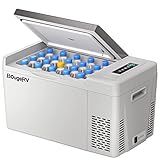
Overview:
The BougeRV CR22 is a streamlined 23-quart compressor fridge/freezer targeting travelers needing portability. At 22.27 lbs and 22.68 x 12.60 x 12.97 inches, it cools from -7°F to 50°F using 12/24V DC or 110–240V AC power. It includes power cords, a manual, and 2-year tech support but omits the partition board found in larger models.
What Makes It Stand Out:
Identical rapid cooling (15 mins to 32°F) and 45W max power consumption as its bigger sibling ensure efficiency, while the 3-level battery protection and 45dB noise operation cater to stealthy, off-road adventures. Its reduced size enhances fitment in smaller vehicles like SUVs or vans.
Value for Money:
Excellent value for solo or duo travelers prioritizing space savings without sacrificing compressor performance. It undercuts pricier dual-zone models while outperforming ice chests in reliability, though the lack of a partition limits storage customization.
Strengths and Weaknesses:
Strengths: Ultra-portable, fast cooling, energy-saving ECO mode, and rugged 30° incline tolerance.
Weaknesses: Smaller capacity may frustrate groups; no internal divider for organization; shorter height reduces vertical storage.
Bottom Line:
A superb choice for minimalist adventurers or compact vehicle owners. Its balance of size, performance, and affordability makes it highly recommended for short trips or space-constrained setups where every pound counts.
3. EUHOMY 12 Volt Refrigerator, 59QT(55L) Electric Cooler, 12V Fridge APP Control, 12V Cooler -4℉~68℉, Portable Freezer 12/24V DC 100-240V AC for Camping, Travel, Truck, Home

Overview:
The EUHOMY 59QT fridge/freezer merges high capacity (55L) with smart tech, cooling from -4°F to 68°F. Its Bluetooth app control, dual storage zones, and UL certification suit campers and home users alike. Includes AC/DC adapters, a manual, and 2-year support.
What Makes It Stand Out:
App-based remote temperature management and dual independent zones prevent odor transfer—a rarity in this class. The variable-frequency compressor hits 32°F in 15 minutes, while the ECO/MAX modes and LCD panel enhance user control beyond basic models.
Value for Money:
Premium pricing is justified by the largest capacity here and unique app functionality, outperforming single-zone alternatives for families. However, app reliability may vary, and thermoelectric competitors are cheaper (but less efficient).
Strengths and Weaknesses:
Strengths: Spacious dual zones, app convenience, energy-efficient (45W avg), and home/car versatility.
Weaknesses: App dependency could frustrate tech-averse users; bulkier size (59QT) limits vehicle fitment; no physical child lock mentioned.
Bottom Line:
Best for tech-savvy users needing ample space and smart features. Despite minor app risks, its cooling prowess and dual-zone design earn a solid recommendation for group outings or hybrid home/camping use.
4. Feelfunn 12 Volt Refrigerator Car Fridge - 40QT(38L) Dual Zone Electric Cooler, Car Refrigerator -4℉~68℉, Portable Refrigerator 12/24V DC 100-240V AC, Portable Freezer for Travel Camping RV Home

Overview:
The Feelfunn 40QT cooler offers dual-zone independent temperature control (-4°F to 68°F) in a 38L capacity. Designed for RVs, boats, and tailgating, it includes LED lighting, a drain plug, and 1-year warranty. Power options cover 12/24V DC and 100–240V AC.
What Makes It Stand Out:
True independent dual-zone operation (unlike partitioned single-zone models) eliminates odor mixing, while rapid 15-minute cooling and ultra-quiet 45dB operation enhance usability. The anti-shake design handles 40° inclines, and ECO mode sips just 30W.
Value for Money:
Mid-priced for a dual-zone compressor unit, it delivers exceptional utility for couples or small groups separating drinks from food. Outperforms single-zone rivals in flexibility, though the 1-year warranty lags behind BougeRV’s 2-year coverage.
Strengths and Weaknesses:
Strengths: Genuine dual-zone control, rugged off-road stability, user-friendly drain plug, and energy-sipping ECO mode.
Weaknesses: Shorter warranty; MAX mode (50W) slightly less efficient than competitors; no app connectivity.
Bottom Line:
A top-tier pick for those prioritizing compartmentalization without tech complexity. Its durability, quiet operation, and practical design make it highly recommended for versatile mobile cooling needs.
5. Antarctic Star 12 Volt Refrigerator,68QT(64L)Electric Cooler Compressor, -4℉~68℉ Portable Refrigerator,Car Fridge 12/24V DC 100-240V AC Portable Freezer with Wheels&2 Baskets for Camping,RV,Car,BLACK

Overview:
The Antarctic Star 68QT behemoth (64L) targets group adventures with wheeled mobility and dual baskets. Cooling from -4°F to 68°F, it features a pull rod, child lock, and dual compressor modes. Compatible with 12/24V DC and 100–240V AC power.
What Makes It Stand Out:
The suitcase-style wheels and pull rod revolutionize portability for its massive capacity, while one-touch refrigeration/freezer switching simplifies use. Child lock and dual-mode compressor (ECO/normal) cater to families, and the drain plug eases cleaning.
Value for Money:
Priced for bulk storage, it’s ideal for large groups but overkill for solo travelers. The wheels justify a slight premium over static 60+QT models, though app-less operation lags behind EUHOMY for tech seekers.
Strengths and Weaknesses:
Strengths: Unmatched capacity with mobile convenience, robust build, useful drain plug, and family-friendly child lock.
Weaknesses: Bulky for most vehicles; no app control; 3-level battery protection less detailed than competitors’ implementations.
Bottom Line:
Essential for group campers or tailgaters needing walk-behind convenience. Despite minor tech gaps, its practical design and sheer volume earn a strong recommendation for heavy-duty outdoor refrigeration.
6. BougeRV 12 Volt Refrigerator 12V Car Fridge 23 Quart Portable Freezer Compressor Cooler 12/24V DC 110~240V AC for Truck Van RV SUV Boat Travel Camping Road Trips Tailgating -8℉~50℉ (Black)

Overview: The BougeRV CR22 is a 23-quart portable compressor fridge/freezer designed for versatile mobile use across vehicles, boats, and camping trips. Its compact size (22.68" x 12.60" x 12.97") and 22.27 lb weight make it highly portable, while dual power compatibility (12V/24V DC and 110–240V AC) ensures flexibility. It cools to -8°F and includes 2-year tech support.
What Makes It Stand Out: Rapid cooling is its hallmark—dropping from 77°F to 32°F in 15 minutes and to -5°F in 50 minutes without ice. The 3-level voltage battery protection prevents vehicle battery drain, and its shock-proof design handles 30° inclines for off-road reliability. At 45dB, it operates quietly for campsite comfort.
Value for Money: Priced competitively for a 23QT compressor unit, it outperforms cheaper thermoelectric coolers in cooling speed and temperature range. The 2-year support and low 36W ECO-mode consumption enhance long-term savings, though larger-capacity models exist at similar price points.
Strengths and Weaknesses:
Strengths: Fast cooling, lightweight, excellent battery protection, quiet operation, and robust off-road stability.
Weaknesses: Limited 23QT capacity for large groups; no app control or dual-zone cooling.
Bottom Line: Ideal for solo travelers or couples needing reliable, compact refrigeration. Its speed and durability justify the cost for road trips, though larger families may prefer higher-capacity alternatives.
7. BougeRV 12V Portable Refrigerator Fridge Freezer Portable Car Fridge 53 Quart Electric Cooler12V/24V DC 110~240 V AC for RV Truck Jeep Pickup SUV Van Boat Camping Tailgating Road Trip Outdoor Travel

Overview: BougeRV’s 53-quart model targets extended group trips with ample storage for week-long adventures. Certified with CE/FCC standards, it cools to -4°F and supports dual power (12V/24V DC, 110–240V AC). The single-zone design uses compressor tech for efficient freezing but lacks independent temperature zones.
What Makes It Stand Out: Its standout feature is the large 53QT capacity—perfect for families—while maintaining rapid cooling (77°F to 32°F in 15 mins, -4°F in 60 mins). The 3-level battery monitor prevents vehicle drain, and 45dB noise levels ensure quiet operation during camping. ECO mode keeps power use under 45W.
Value for Money: Excellent for groups given its size-to-price ratio. It undercuts premium brands like Dometic while matching core performance. However, the single-zone limitation slightly reduces versatility versus dual-zone competitors at higher price points.
Strengths and Weaknesses:
Strengths: Spacious capacity, fast cooling, energy-efficient ECO mode, and reliable battery protection.
Weaknesses: Single-zone cooling restricts flexibility; the smaller compartment relies on airflow from the main zone, risking uneven temps.
Bottom Line: A top pick for families or group travelers needing bulk storage without breaking the bank. Prioritize if capacity trumps zoned cooling, but consider dual-zone models for precise temperature control.
8. Feelfunn Car Fridge Portable 12 Volt Refrigerator - 58 Quart(55L) Electric Cooler with AC/DC for Truck RV Van Camper, Car Refrigerator Freezer for Camping Boat Travel, APP Control, -4~68°F

Overview: The Feelfunn 58QT (55L) fridge/freezer combines massive capacity with smart technology, cooling from -4°F to 68°F. Designed for large gatherings, it offers dual power (12V/24V DC, 110–240V AC), Bluetooth app control, and a durable build stable at 30° inclines.
What Makes It Stand Out: App control for remote temperature adjustments and battery monitoring is a game-changer. It stores up to 58 cans or 18 wine bottles, with a dual-storage layout. Cooling takes 15 mins (68°F→32°F) and 75 mins to -4°F. The 40dB operation is quieter than most competitors.
Value for Money: Premium pricing is justified by app integration and industry-leading capacity. While costlier than basic models, it saves money versus buying standalone coolers for large groups. ECO mode (45W avg.) ensures efficiency, though freeze times lag behind rivals.
Strengths and Weaknesses:
Strengths: Largest capacity here, app control, quiet 40dB operation, and flexible storage.
Weaknesses: Slowest freeze time (75 mins); app reliance may frustrate tech-averse users.
Bottom Line: Best for tech-savvy adventurers hosting groups who value convenience and space. Worth the investment if app features and capacity outweigh slightly slower freezing.
9. BougeRV 12V Refrigerator Fridge Freezer Portable Car Fridge 42 Quart Electric Cooler 12V/24V DC 110~240V AC for RV Camper Truck Jeep Pickup SUV Van Boat Camping Tailgating Road Trip Outdoor Travel

Overview: BougeRV’s 42QT model bridges capacity gaps between their smaller and larger units, targeting mid-sized groups with a -4°F to 50°F range. It shares core features with their 53QT version but in a more compact footprint, suitable for week-long trips.
What Makes It Stand Out: Rapid cooling (77°F→32°F in 15 mins, -4°F in 60 mins) and 3-level battery protection mirror their larger sibling. The 42QT size fits tighter spaces in Jeeps or vans while still storing ample food. ECO mode draws <45W, and 45dB noise ensures campsite tranquility.
Value for Money: Offers the sweet spot between capacity and affordability. It costs less than the 53QT model but sacrifices minimal utility for most families. Lacks app control or dual zones, yet BougeRV’s 2-year support adds reliability.
Strengths and Weaknesses:
Strengths: Balanced capacity, fast cooling, energy efficiency, and dependable battery safeguards.
Weaknesses: Single-zone cooling; smaller compartment depends on main zone airflow, risking inconsistent temps.
Bottom Line: A practical choice for couples or small families needing more space than 23QT models but less bulk than 53QT. Opt for this if space efficiency and proven performance matter most.
10. Feelfunn 12V Refrigerator - 27QT(25L) Portable Freezer, Electric Cooler for Car, Truck, RV, Van, Camping & Road Trip, Fast Cooling Fridge with 12/24V DC & 110-240V AC for Vehicle & Home Use,-4℉~68℉

Overview: Feelfunn’s 27QT fridge excels in speed and smart features, cooling from 77°F to -4°F in just 45 minutes. It supports dual power, includes a built-in ice pack for 50-hour runtime during outages, and offers Bluetooth app control for remote management.
What Makes It Stand Out: Unmatched freezing speed (45 mins to -4°F) and smartphone app integration set it apart. The ice pack extends cooling during power loss, while 45dB noise and 40° slope stability suit rugged use. ECO mode sips just 28W (<1kWh/day).
Value for Money: Priced higher than basic 27QT units, but app control, rapid freezing, and 50-hour backup justify the cost. Beats competitors in energy efficiency, though capacity is smaller than BougeRV’s 42QT/53QT options.
Strengths and Weaknesses:
Strengths: Blazing-fast cooling, app convenience, 50-hour battery life, and ultra-low 28W ECO consumption.
Weaknesses: 27QT capacity may be tight for families; app dependency could be a drawback offline.
Bottom Line: Perfect for solo travelers or tech-focused users prioritizing speed and smart features. Choose this over larger models if rapid freezing and app control outweigh raw capacity needs.
Understanding Your Core Cooling Needs
Before diving into technical specs, it’s crucial to honestly assess how you actually use your RV. This foundational step prevents overspending on unnecessary bells and whistles or, worse, ending up with a unit too small for your lifestyle. Your usage pattern dictates nearly every other decision.
Defining Your Trip Profile
Are you primarily weekend warriors making short hops to established campgrounds with reliable shore power? Or do you dream of extended off-grid excursions deep in national forests, relying solely on your RV’s battery bank and solar panels? Boondockers need units with exceptional energy efficiency and robust battery protection, while park campers might prioritize features like rapid cooling from a warm start when plugged in. Consider your average trip duration, typical group size, and whether you cook elaborate meals requiring significant fresh ingredient storage versus simpler fare.
Capacity: Beyond Just Cubic Feet
While capacity (measured in quarts or liters) is a primary filter, it’s not just about the number. Think about what you need to store. Do you require dedicated freezer space for frozen meals or ice cream, or is chilled drinks and perishables your main focus? Units with adjustable thermostats allow a single compartment to function as fridge, freezer, or anything in between, offering flexibility. Dual-zone units provide independent temperature control for separate fridge and freezer compartments – ideal for households with diverse needs but often larger and more power-hungry. Measure your intended installation space precisely, including door swing clearance and ventilation requirements, as RV storage nooks can be oddly shaped.
Key Technologies Powering Modern Portable Cooling
The heart of any portable fridge is its cooling technology. Understanding the differences is paramount, as it impacts performance, efficiency, noise, and suitability for your RV lifestyle. The main contenders are compressor-based and absorption systems, each with distinct characteristics.
Compressor Cooling: The Off-Grid Champion
Modern 12V/24V DC compressor refrigerators are the dominant choice for serious RVers, especially those venturing off-grid. They work similarly to household fridges, using a sealed compressor to circulate refrigerant. Their key advantage is superior energy efficiency, particularly when running on battery power. They maintain consistent, low temperatures regardless of ambient conditions or vehicle orientation, making them perfect for travel. They can reliably reach true freezing temperatures (-10°F/-23°C or lower) and cool down quickly. While generally more expensive upfront, their efficiency translates to longer boondocking times and less strain on your electrical system. Modern units are significantly quieter than older models.
Absorption Refrigeration: Simplicity with Limitations
Absorption fridges, often found built into older RVs, use heat (from propane, 120V AC, or sometimes 12V DC) to drive the cooling cycle instead of a mechanical compressor. Their main appeal is silent operation (no moving parts besides possibly a fan) and the ability to run directly on propane, conserving battery power. However, they are significantly less efficient than compressor units, especially when running on electricity. They struggle to maintain low temperatures in hot ambient conditions (above 90°F/32°C), cool down slowly, and are highly sensitive to being perfectly level. They also cannot maintain true freezer temperatures consistently. While useful as a supplement or in specific scenarios, they are generally not the best primary portable solution for modern, flexible RVing.
Powering Your Portable Fridge: Beyond the Plug
Your chosen unit’s power demands must align seamlessly with your RV’s electrical system and your typical camping style. Mismatched power requirements are a common source of frustration and potential system damage.
Voltage Compatibility: 12V, 24V, or Multi-Voltage?
Most portable RV fridges operate primarily on 12V DC, drawing power directly from your vehicle’s starting battery or, preferably, your dedicated house battery bank. Crucially, ensure your unit matches your RV’s nominal system voltage (12V or 24V). Using a 12V fridge on a 24V system without a converter will destroy it. Many modern units are “dual voltage” (12V/24V DC), automatically adapting – a highly recommended feature for flexibility. Also, verify if it includes 120V AC capability for use when plugged into shore power or a generator, which is standard but good to confirm.
Energy Consumption: The Boondocking Lifeline
This is arguably the most critical spec for off-grid travelers. Look for the unit’s average amp-hours per 24 hours (Ah/24h) consumption, measured under standardized conditions (e.g., 77°F ambient, set to 39°F). Lower numbers mean longer runtime on your batteries. Be wary of peak startup current (inrush current), which can be 3-5x the running current; ensure your wiring, fuses, and battery monitor can handle it. Compare units carefully – a difference of 0.5 Ah/24h can mean hours of extra runtime. Factor in your total daily power budget; your fridge shouldn’t consume more than 25-40% of your usable house battery capacity for multi-day boondocking.
Smart Power Management Features
Advanced units incorporate intelligent features to protect your electrical system. Low Voltage Cutoff (LVC) is essential; it automatically shuts the fridge down before your house battery is drained to a dangerous level (typically around 11.8V - 12.0V for 12V systems), preventing a dead battery that won’t start your engine or run other essentials. Adjustable LVC thresholds offer more control. Battery Mode optimizes compressor run time specifically for battery operation, prioritizing efficiency over rapid cooling. Some units even integrate with solar charge controllers for smarter power allocation.
Design and Usability: Fitting Your RV Lifestyle
Beyond the core tech and power needs, how the unit integrates into your RV and daily routine significantly impacts satisfaction. Consider ergonomics, durability, and features that enhance practicality on the road.
Form Factor and Installation Flexibility
Portable fridges come in various shapes: traditional top-opening chests, front-opening units (resembling mini household fridges), and versatile convertible models. Top loaders are generally the most energy-efficient (cold air doesn’t spill out when opened) and often more rugged, ideal for mounting in cargo areas or truck beds. Front loaders offer easier access, especially when installed under counters, mimicking a household experience but can be less efficient and potentially less stable on uneven terrain. Consider mounting options – many units have integrated brackets or grooves for secure strapping. Will it sit on the floor, fit under a counter, or mount in a slide-out? Measure twice!
Build Quality and Ruggedness
The open road is demanding. Look for rotomolded polyethylene exteriors – they are incredibly tough, impact-resistant, and often provide better insulation than cheaper ABS plastic. Stainless steel handles and hinges add durability. Check the IP (Ingress Protection) rating; a rating like IP65 indicates resistance to dust and low-pressure water jets, crucial for use in wet campgrounds or dusty trails. Adequate insulation thickness (look for 1.5+ inches) is vital for maintaining temperatures and efficiency, especially in hot climates. Don’t underestimate the importance of a solid, non-slip base.
Interior Layout and Features
A well-designed interior maximizes usable space. Look for removable baskets or dividers for flexible organization – keeping produce separate from dairy, or creating zones for drinks. Drain plugs are invaluable for easy cleaning after transporting frozen items or if condensation builds up. Interior lighting (LED, preferably dimmable) makes finding items at night much easier. Consider the door seal quality; a robust, multi-point latch ensures a tight seal, critical for efficiency. Some units offer external temperature displays or even USB charging ports on the lid – small conveniences that add up.
Advanced Features: Convenience vs. Cost
As technology advances, portable fridges offer more “smart” features. Evaluate these based on your actual needs and whether the added cost and potential complexity are justified for your usage.
App Connectivity and Remote Monitoring
Bluetooth or Wi-Fi connectivity allows you to monitor and adjust temperatures, check battery voltage, receive low-temperature alerts, and sometimes even track power consumption via a smartphone app. This is incredibly convenient for peace of mind, especially when the fridge is stored in a garage compartment or you’re away from the RV. However, it adds cost, requires a compatible phone, and consumes a small amount of extra power. Ensure the app is user-friendly and reliable – check reviews specifically for app performance.
Dual-Zone Functionality Explained
Dual-zone units feature two completely separate compartments, each with its own thermostat and evaporator. This allows you to have a dedicated freezer section (consistently at 0°F/-18°C or below) and a refrigerator section (around 35°F-38°F/2°C-3°C) simultaneously. It’s ideal for households that want frozen items readily available without compromising fresh food storage. However, dual-zone units are almost always larger, heavier, more expensive, and consume significantly more power than comparable single-zone models. Only opt for dual-zone if you have a proven, consistent need for substantial dedicated freezer space.
Specialized Use Cases and Accessories
Consider if you need features tailored to specific adventures. 4WD-specific models often boast enhanced shock/vibration resistance and extreme temperature tolerance. Marine-rated units have superior corrosion protection for salty environments. Accessories like custom mounting brackets, insulated lid covers (for extra efficiency in extreme heat), external slide-out drawers, or solar generator compatibility kits can enhance functionality but add to the overall investment. Prioritize core performance first; add accessories later if needed.
Installation and Integration: Setting Up for Success
Even the best portable fridge will underperform or cause problems if not installed correctly within your RV’s ecosystem. Proper setup is non-negotiable for safety, efficiency, and longevity.
Electrical Wiring: Safety First
Never plug a portable fridge directly into a standard RV 12V outlet (like a cigarette lighter socket). These are designed for low-draw accessories (phones, pumps) and cannot handle a fridge’s startup current, posing a serious fire hazard. You must wire it directly to your house battery bank using appropriately sized marine-grade copper wire (consult the unit’s manual for gauge requirements, often 10-8 AWG), proper fusing (ABYC standards recommend a fuse within 7" of the battery positive terminal), and a battery isolator or DC-DC charger if connecting to the starting battery. This ensures sufficient power delivery and protects your entire electrical system. If unsure, hire a qualified RV electrician.
Ventilation and Ambient Temperature
Compressor units generate heat at the condenser (usually on the sides or back). Adequate clearance (typically 3-6 inches on all sides, especially rear/sides) is mandatory for this heat to dissipate. Blocking vents causes the compressor to overwork, drastically reducing efficiency, increasing power draw, and shortening the unit’s lifespan. Avoid installing the fridge in enclosed, unventilated compartments like under seats without forced airflow. Also, be realistic: ambient temperature matters. Units struggle far more to maintain freezing temps when ambient temps soar above 90°F (32°C). Pre-cool the unit and contents before heading into extreme heat.
Leveling and Stability
While modern compressor fridges are far less sensitive to leveling than absorption models, operating significantly off-level can still reduce efficiency and potentially cause issues over time. Aim for your RV to be as level as practical when stationary for extended periods. Ensure the fridge itself is securely mounted or strapped down to prevent movement during travel. A shifting fridge is a safety hazard and can damage both the unit and your RV.
Maximizing Performance and Longevity
Owning a portable fridge is an investment. Simple habits and maintenance routines ensure it delivers peak performance for years, keeping your food safe and your adventures smooth.
Pre-Cooling and Smart Loading Practices
Always pre-cool your fridge several hours (or ideally overnight) while connected to shore power or your vehicle engine before loading it with warm food or heading off-grid. A warm interior forces the compressor to work much harder initially, draining precious battery power. Similarly, cool contents before loading – never put room-temperature items directly into a cold fridge. Organize items to allow air circulation; avoid overpacking, especially blocking vents inside the unit. Use the baskets for organization but leave space around items.
Maintenance: Simple but Essential
Routine care prevents most problems. Clean the interior regularly with mild soap and water; avoid harsh chemicals. Wipe up spills immediately. Check and clean the condenser coils/fins (located on the sides or back) every few months, especially if used in dusty environments – compressed air works well. Ensure door seals are clean and intact; a damaged seal lets cold air escape. Defrost manually if frost builds up excessively (though most modern units are frost-free, very humid conditions can cause some buildup). Periodically check all electrical connections for tightness and corrosion.
Understanding Real-World Efficiency
Manufacturer specs are measured in ideal lab conditions. Your actual runtime will vary based on: Ambient temperature (hotter = more power), Set temperature (colder = more power), Frequency of opening (every opening = warm air influx), Insulation of contents (fuller fridge retains cold better), and Battery health/voltage. Use the spec sheet as a baseline for comparison, but monitor your own unit’s consumption with a battery monitor (like a shunt-based system) to understand its real-world impact on your setup. Adjust habits (like minimizing door openings in heat) to optimize.
Frequently Asked Questions
Frequently Asked Questions
How long will a portable RV fridge run on my house batteries?
Runtime depends entirely on your battery capacity (usable amp-hours), the fridge’s consumption (Ah/24h), and ambient conditions. Calculate: (Usable Battery Capacity) / (Fridge Consumption) = Approximate Days. E.g., 100Ah usable / 2.0 Ah/24h = 50 hours. Always factor in other loads and avoid draining batteries below 50% depth of discharge for longevity.Can I run a portable fridge while driving my RV?
Yes, absolutely, and it’s highly recommended to maintain food safety. Ensure it’s securely mounted and wired directly to the house battery (not a cigarette lighter socket). Running on the vehicle’s alternator while driving is the most efficient way to power it, as the alternator recharges the batteries.Do I really need a dual-voltage (12V/24V) fridge?
If your RV has a standard 12V system, a 12V-only unit is sufficient. However, a dual-voltage (12V/24V) unit offers significant flexibility. It’s essential if you have a 24V truck or RV system, and it future-proofs your purchase if you ever upgrade. The minor cost difference is usually worth the versatility.Why is my portable fridge freezing up inside?
Excessive frost or ice buildup is usually caused by humid air entering the unit. This happens when the door is opened frequently, left open too long, or if the door seal is damaged/dirty. Ensure the seal is clean and intact, minimize door openings (especially in humid weather), and allow space for air circulation inside. Most units have a drain plug to remove accumulated water.Can I use a portable power station (solar generator) to run my RV fridge?
Yes, most modern portable power stations with a pure sine wave AC inverter (or sufficient DC output) can run compressor fridges. Check the fridge’s starting wattage (surge) and running wattage against the power station’s continuous and surge ratings. Prioritize units with lower amp-hour consumption for longer runtime on limited battery capacity.Is it safe to run a portable fridge on propane?
Most compressor-based portable fridges do not run on propane; they require DC or AC power. Only absorption refrigerators use propane. Compressor units are generally safer for RV use as propane systems require ventilation, leak checks, and pose combustion risks. Stick with DC-powered compressor fridges for primary portable cooling.How do I prevent my fridge from draining my RV’s starting battery?
Never wire a portable fridge directly to your starting battery. Always connect it to your dedicated house battery bank. Use a battery isolator or DC-DC charger to allow the alternator to charge the house bank while driving without connecting the batteries directly when parked. Ensure your house bank is sufficiently sized for your fridge’s consumption.What’s the difference between a “fridge” and a “fridge/freezer”?
A standard “fridge” typically maintains temperatures only in the refrigeration range (34°F-40°F / 1°C-4°C). A “fridge/freezer” (usually single-zone) can cool down to true freezing temperatures (0°F / -18°C or lower) throughout the entire compartment, but you can’t have separate fridge and freezer zones simultaneously. Dual-zone units offer two independent compartments.How important is the insulation thickness?
Extremely important. Thicker insulation (1.5 inches or more is good) significantly reduces the amount of energy needed to maintain cold temperatures, especially in hot weather. It directly impacts efficiency, battery runtime, and the unit’s ability to keep contents frozen. Don’t sacrifice insulation thickness for a slightly smaller exterior footprint.Can I install a portable fridge in my RV’s existing absorption fridge cavity?
Sometimes, but careful measurement and planning are crucial. Portable compressor units often have different dimensions, venting requirements (side/rear vs. bottom absorption vents), and electrical needs. You’ll likely need to modify the cavity for proper ventilation clearance and run new dedicated wiring. Ensure the portable unit fits with required clearances and that the location isn’t excessively hot (like near engine compartments).